
| Genus | Species | Beginner | Rarity |
|---|---|---|---|
| Puntigrus | Tetrazona | ✅ | Very Common |
| Pethia | Nigrofasciata | ✅ | Uncommon |
| Barbodes | Semifasciolatus | ✅ | Common |
| Sahyadria | Denisonii | ✅ | Common |
| Puntius | Titteya | ✅ | Very Common |
| Desmopuntius | Pentazona | ❌ | Uncommon |
| Oliotius | Oligolepis | ✅ | Uncommon |
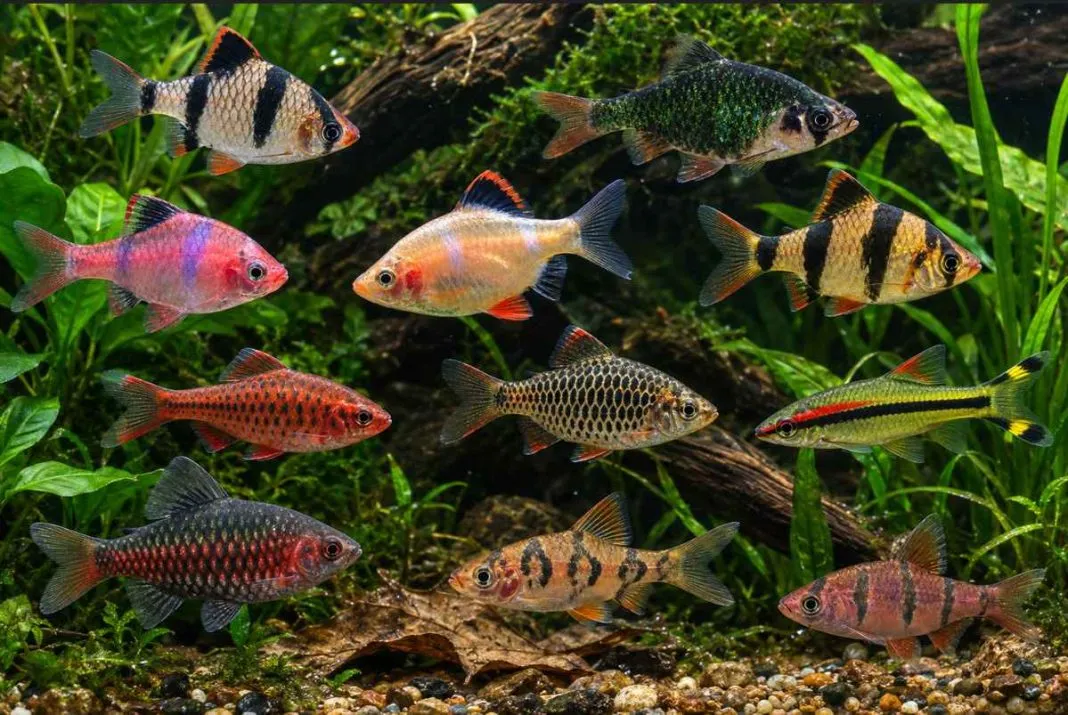
Selective breeding has produced a wide range of colors, patterns, and phenotypes among the many types of barb fish available in the aquarium trade today. Depending on the species or variety, freshwater barbs may display shades of orange, black, green, red, yellow, silver, and many other colors.
The tiger barb (Puntigrus tetrazona), rosy barb (Pethia conchonius), and gold barb (Barbodes semifasciolatus) are among the more commonly kept freshwater barbs. Some species, particularly the tiger barb, are also available in several selectively bred color varieties.
Classification of Freshwater Barb Species
Freshwater barbs belong to several genera within the family Cyprinidae. Historically, many Asian barb species were grouped within the genus Puntius, but taxonomic research has since demonstrated that this broad grouping contained several distinct evolutionary lineages. A major revision reorganized many South Asian species and established or recognized several more distinct genera.
Common aquarium barbs are now distributed among genera such as Pethia, which includes the black ruby, odessa, and rosy barbs; Barbodes, which includes the gold barb; Puntigrus, which includes the tiger barb; and Desmopuntius, which includes the five-banded, striped, snakeskin rhombo, and six-banded barbs.
Species should not be confused with selectively bred varieties. The tiger barb (Puntigrus tetrazona), for example, is a popular aquarium fish available in several varieties, including the green tiger barb, albino tiger barb, and other selectively bred color varieties. Although these fish can look quite different, they all belong to the same species.
Popular Barb Fish Varieties
Freshwater barbs include a diverse range of species that vary considerably in size, coloration, markings, temperament, and care requirements. The different types of freshwater barbs below include many of the most popular and unique varieties found in the aquarium hobby.
Tiger Barb
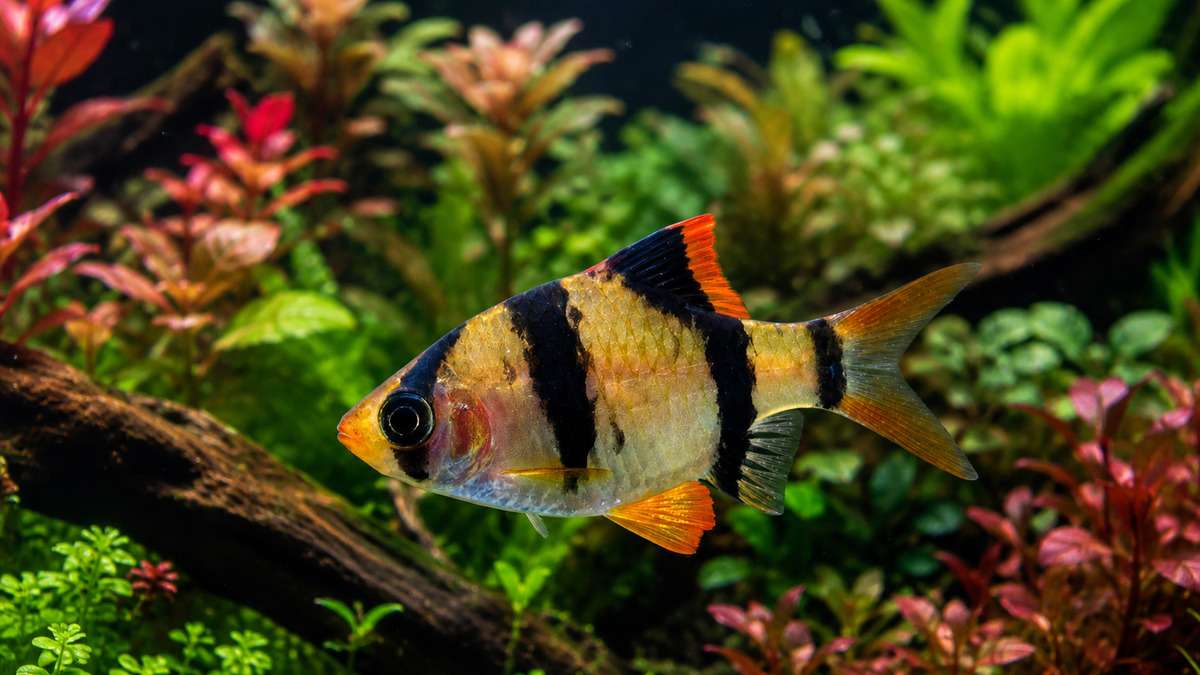
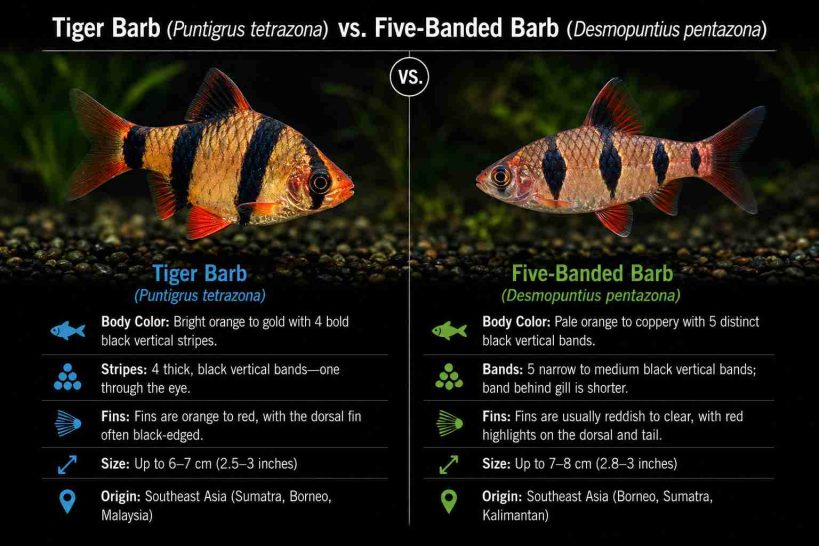
The tiger barb (Puntigrus tetrazona) is one of the most recognizable freshwater barbs, identified by its golden to orange body crossed by four prominent black vertical bands. Adults typically develop reddish-orange coloration around the fins and snout, with males generally displaying stronger coloration than females.
Compared with many peaceful barb species, tiger barbs are more energetic and prone to fin-nipping, particularly when kept in smaller groups. Their active schooling behavior and bold red and black markings make them easy to distinguish from similar species such as the five-banded barb, which has five dark bands and a more subdued overall appearance.
Black Ruby Barb

The black ruby barb (Pethia nigrofasciata) develops a distinctive combination of black markings and deep pigmentation over a silver-gray to reddish body. Mature males develop their most intense coloration during breeding, with most of their body becoming deep ruby-red with extensive dark pigmentation.
The black ruby barb shares some similarities with tiger barbs, particularly the dark vertical markings seen in younger fish. As they mature, however, black ruby barbs develop a distinctive combination of deep black and ruby-red coloration. They also tend to have a calmer temperament, making them well suited to appropriately stocked community aquariums.
Gold Barb

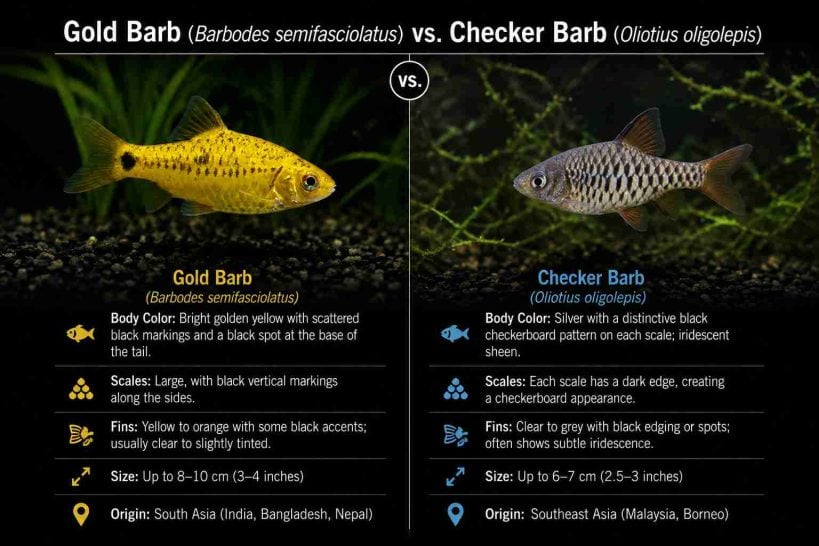
The gold barb (Barbodes semifasciolatus) is commonly recognized by its bright yellow-gold body, reddish fins, and scattered darker markings along the sides. The brilliant gold coloration commonly seen in aquariums is the result of selective breeding, while wild forms are generally less colorful.
Gold barbs are active schooling fish but typically have a more peaceful reputation than tiger barbs. Their combination of golden coloration and scattered markings also makes them visually distinct from the strongly banded barb species featured in this guide.
Green Tiger Barb
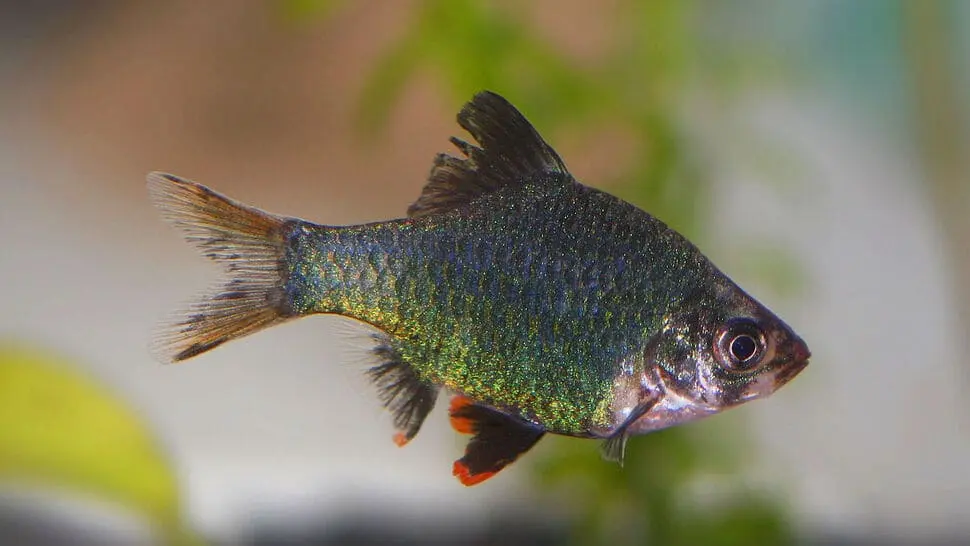
The green tiger barb is a selectively bred variety of Puntigrus tetrazona characterized by extensive dark green to blue-green coloration across much of the body. Unlike tiger barbs with clearly defined vertical bands, green tiger barbs develop extensive dark pigmentation that gives the body its characteristic metallic green to black appearance.
Green tiger barbs are a color variety of the tiger barb, sharing the same general care requirements, temperament, and schooling behavior despite their noticeably different appearance. Both varieties can be kept together, adding greater color and visual variety to a tiger barb school.
Albino Tiger Barb
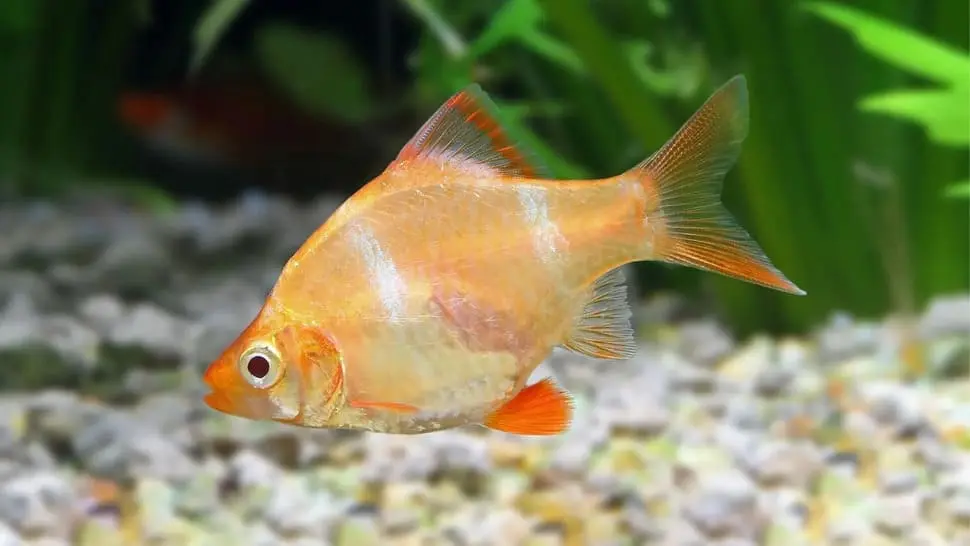
The albino tiger barb is another cultivated variety of Puntigrus tetrazona. It typically has a pale cream to golden-orange body with light-colored or reddish vertical markings rather than the bold black bands found on standard tiger barbs.
Like the green variety, the albino tiger barb is not a separate species. Its behavior, adult size, schooling requirements, and general care are comparable to those of standard tiger barbs, and the different color varieties can easily be kept together.
Odessa Barb

The Odessa barb (Pethia padamya) is a colorful schooling barb characterized by dark markings and, particularly in mature males, a vivid red stripe extending horizontally along the body. Females are generally less colorful, with silvery coloration and less extensive red pigmentation.
The horizontal red coloration makes mature Odessa barbs relatively easy to distinguish. They are highly active schooling fish, with males generally displaying their strongest coloration when maintained under suitable aquarium conditions.
Denison Barb

The Denison barb (Sahyadria denisonii) has an elongated, streamlined body marked by a prominent black horizontal stripe and a bright red stripe extending from the snout through the front portion of the body. Yellow and black markings on the tail further distinguish it from most other freshwater barbs.
Denison barbs grow considerably larger and require substantially more swimming space than smaller species such as cherry, checker, or tiger barbs. Their streamlined body and horizontal markings also give them a distinctive appearance compared with many other commonly kept barbs.
Rosy Barb

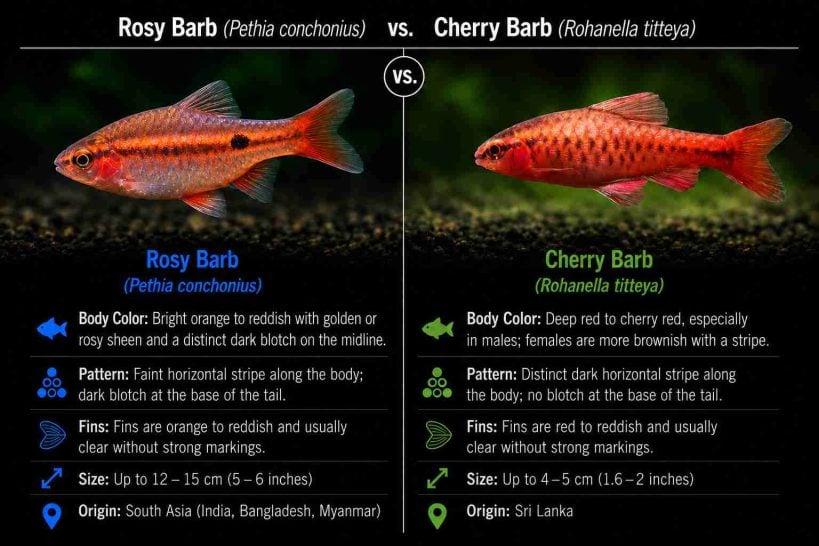
The rosy barb (Pethia conchonius) has a silvery body that can develop pink to red coloration, particularly in mature males. A distinct dark marking near the rear of the body also helps distinguish the species from similar barbs.
Rosy barbs are larger and more robust than small species such as cherry and checker barbs, but lack the prominent vertical bands associated with tiger barbs. They are active schooling fish and are notable for tolerating somewhat cooler aquarium temperatures than many tropical community species.
Cherry Barb

The cherry barb (Rohanella titteya) is a small, slender barb native to Sri Lanka. Males can develop intense cherry-red coloration, particularly when mature or displaying, while females generally retain more subdued brownish to reddish coloration with a prominent horizontal stripe.
Compared with the semi-aggressive tiger barb, cherry barbs are considerably more peaceful and reserved. Their smaller size and calmer behavior make them particularly well suited to planted community aquariums.
Snakeskin Rhombo Barb

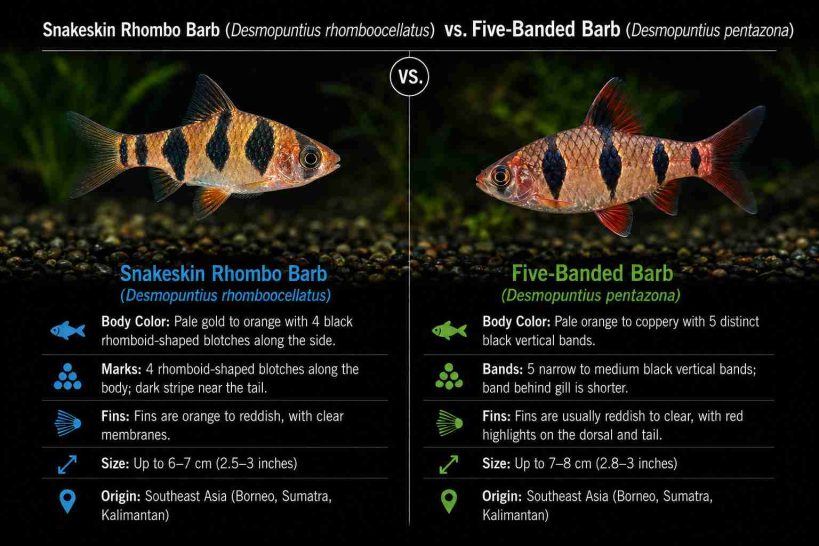
The snakeskin rhombo barb has a distinctive scale pattern and dark rhomboid markings that give it a noticeably different appearance from other Desmopuntius barbs.
Compared with brightly colored species such as cherry or Odessa barbs, the snakeskin rhombo barb stands out primarily through pattern rather than intense coloration. Its distinctive markings make it one of the easier species in this group to recognize.
Five-Banded Barb

The five-banded barb (Desmopuntius pentazona) is characterized by five dark vertical bands crossing an orange-brown to reddish body. It can initially resemble a tiger barb, but its five distinct bands provide an easy way to tell the two species apart.
Tiger and five-banded barbs can be distinguished by the number of vertical bands along their bodies. Tiger barbs characteristically have four prominent black bands, while five-banded barbs have five. Five-banded barbs are also generally more peaceful and less prone to persistent fin-nipping than tiger barbs.
Checker Barb

The checker barb (Oliotius oligolepis) is a small freshwater barb whose scales have dark edging that produces a distinctive checkered or reticulated pattern across the body. Adults can also develop reddish coloration in the fins, with males typically becoming more colorful than females.
Unlike tiger and five-banded barbs, the checker barb does not have prominent vertical bands. Instead, its uniquely outlined scales create a distinctive checkered pattern, while its relatively small size makes it well suited to appropriately stocked community aquariums.
Striped Barb

The striped barb (Desmopuntius johorensis) has an elongated body marked by several dark horizontal stripes extending along its sides. Unlike many commonly kept barbs, the striped barb has prominent horizontal stripes, making it relatively easy to distinguish from similar species.
The striped barb and five-banded barb both belong to Desmopuntius, but their markings run in different orientations. Five-banded barbs have prominent vertical bands, whereas striped barbs display longitudinal stripes running along the body.
How to Identify Similar Types of Barbs
Most freshwater barb species can be distinguished by their body shape, coloration, markings, fin patterns, and the orientation or number of stripes and bands. Some species can appear particularly similar before reaching maturity.
For example, tiger barbs typically have four prominent vertical black bands, while five-banded barbs have five. Checker barbs can be recognized by their uniquely outlined scales, which create a checkered appearance, while striped barbs have dark horizontal stripes running along the body.
Other freshwater barbs that may appear similar at first glance include:
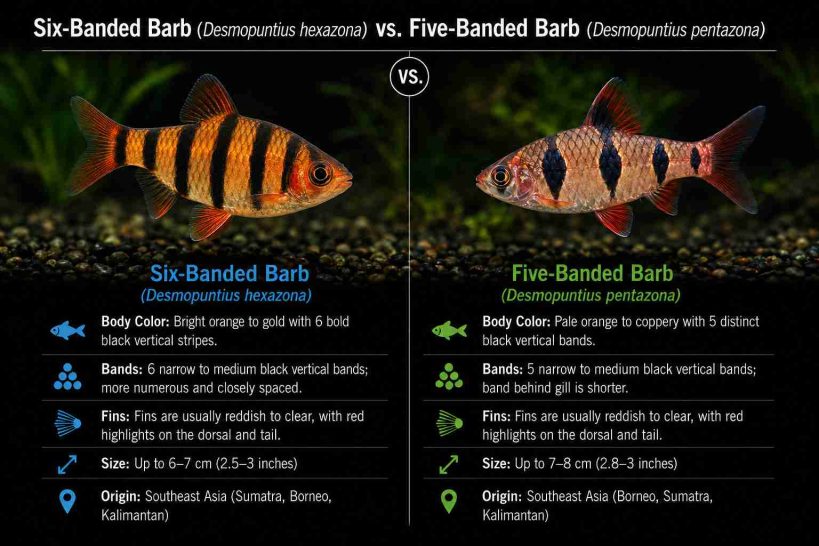
Six-Banded Barb vs Five-Banded Barb
Gold Barb vs Checker Barb
Tiger Barb vs Five-Banded Barb
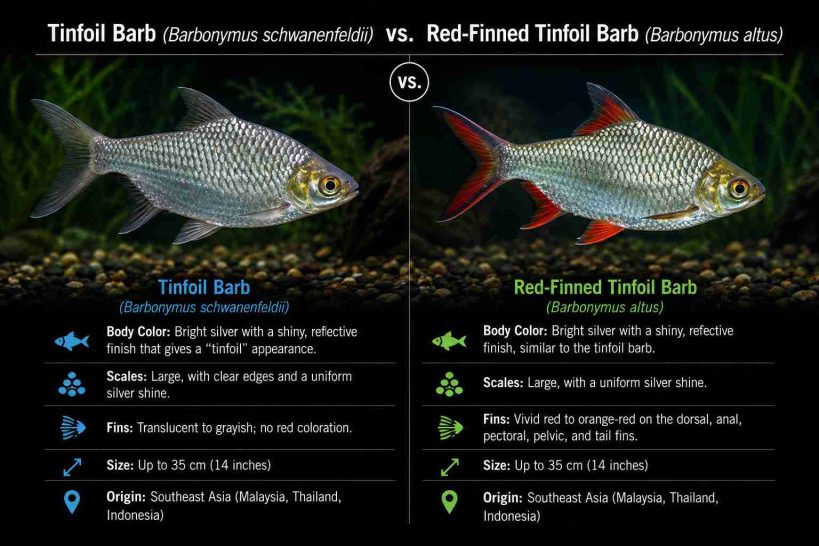
Tinfoil Barb vs Red-Finned Tinfoil Barb
Rosy Barb vs Cherry Barb
Snakeskin Rhombo Barb vs Five-Banded Barb
Frequently Asked Questions
How many species of barb fish are there?
There are hundreds of fish commonly referred to as barbs within the family Cyprinidae, although modern taxonomy divides them among numerous genera rather than a single “barb” group. Only a relatively small number are commonly kept in home aquariums, including species from Puntigrus, Pethia, Desmopuntius, Barbodes, and Barbonymus.
What are the most popular types of barb fish?
Some of the most popular aquarium barbs include Tiger Barbs, Cherry Barbs, Rosy Barbs, Gold Barbs, Odessa Barbs, Denison Barbs, Black Ruby Barbs, and Tinfoil Barbs. They vary considerably in adult size, coloration, temperament, and schooling behavior, making some species better suited to community aquariums than others.
What is the difference between barb species and varieties?
A barb species is a distinct taxonomic species, such as the Tiger Barb (Puntigrus tetrazona) or Cherry Barb (Rohanella titteya), whereas a variety is a different color, pattern, fin, or other phenotype within the same species. For example, Green and Albino Tiger Barbs are aquarium varieties of Puntigrus tetrazona, not separate species.
About Our Species Profiles
ForAquarium species guides combine scientific literature and established taxonomic references with years of aquarium-keeping experience. Information is periodically reviewed and updated as new research becomes available.
Published Literature
Frankel JS. Inheritance of trunk striping in the Sumatran tiger barb, Barbus tetrazona. Journal of Heredity (1985)
K B Li, O Q Chang, F Wang, C Liu, Q Wang, F L Liang, B Y Ma, and S Q Wu. Identification of a transparent mutant tiger barb Puntius tetrazona and its use for in vivo observation of a Pleistophora sp. (Microsporidia) infection. Journal of Fish Biology (2012)
Lindstrom A and Volkoff H. Endocrine regulation of feeding in non-transgenic and transgenic fluorescent orange tiger barb (Puntigrus tetrazona) (2025)
Santhakumar Kirankumar and Thavamani Jegajothivel Pandian. Production and progeny testing of androgenetic rosy barb Puntius conchonius (2004)
G Mitra, J K Jena, P Jayasankar, P C Das, and S K Swain. Evaluation of colour development of rosy barb, Puntius conchonius (Hamilton) during ontogeny (2013)
Jham Lal, Pradyut Biswas, Soibam Khogen Singh, Reshmi Debbarma, Suparna Deb, Nitesh Kumar Yadav, and Arun Bhai Patel. Effects of dietary aromatase inhibitors on masculinization of rosy barb (Pethia conchonius): Evidence from growth, coloration and gonado-physiological changes (2023)
Justin M Stilwell, Alvin C Camus, and Natalie K Stilwell. Gonadal neoplasia in Chinese gold barbs (Barbodes semifasciolatus) from a home aquarium (2024)
Maurice Kottelat. The fishes of the inland waters of Southeast Asia: A catalogue and core bibliography of the fishes known to occur in freshwaters, mangroves and estuaries. (2013)
Pethiyagoda, R. Haludaria, a replacement generic name for Dravidia (Teleostei: Cyprinidae) (2013)