

| Genus | Species | Beginner | Rarity |
| Pterophyllum | Altum | ❌ | Rare |
| Pterophyllum | Leopoldi | ❌ | Very Rare |
| Pterophyllum | Scalare | ✅ | Common |
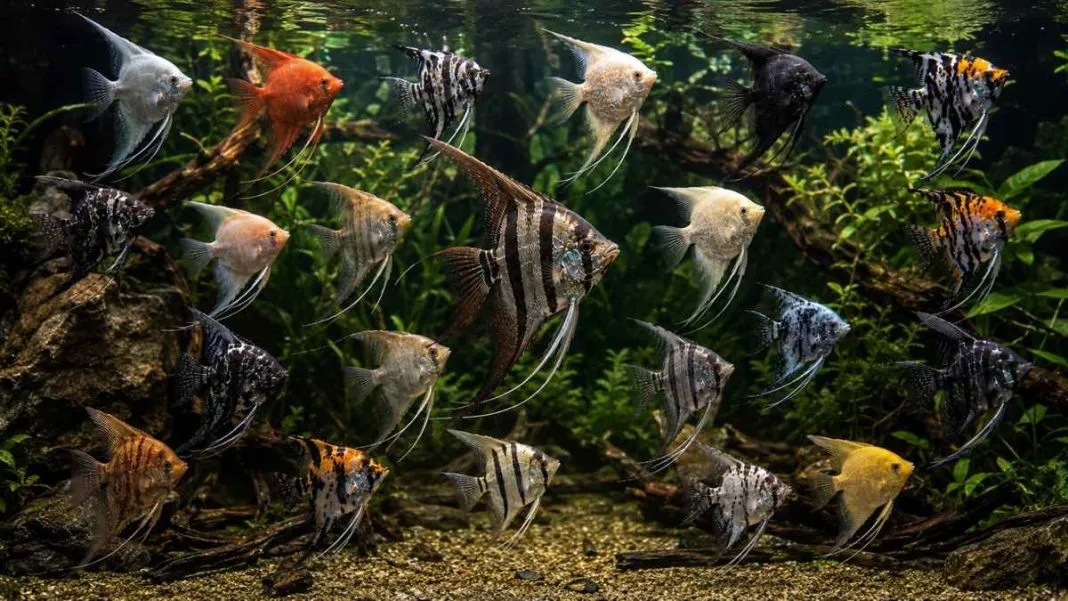
Through selective breeding, aquarium hobbyists have developed many different varieties of Pterophyllum scalare, producing a wide range of freshwater angelfish colors, patterns and phenotypes available today. Freshwater angelfish colors can range from silver, white and black to gold, orange, blue and combinations of several colors and patterns.
While these angelfish may look remarkably different from one another, most belong to the same species and can be identified by distinctive characteristics such as size, body color, stripe patterns, markings, dorsal fins, and scale texture.
How to Identify Freshwater Angelfish
Identifying freshwater angelfish starts with determining whether the fish is one of the three Pterophyllum species of angelfish or a selectively bred Pterophyllum scalare variety. Freshwater angelfish can be identified by their differences in color, stripes, markings, eye color and scale texture.
When trying to identify an angelfish, look closely at:
Body color: white, silver, black, gold, orange or blue
Stripe pattern: number of stripes, thickness and location of vertical bars
Body markings: spots, marbling, patches, fading and variations in pigmentation
Eye colour: particularly the red eyes associated with albino varieties
Scale texture: Pearlscale angelfish have a distinctive wrinkly appearance
Head and nose shape: useful when distinguishing Altum from Scalare
Dorsal fin and overall size: particularly useful for identifying Leopoldi
Freshwater Angelfish Species Comparison
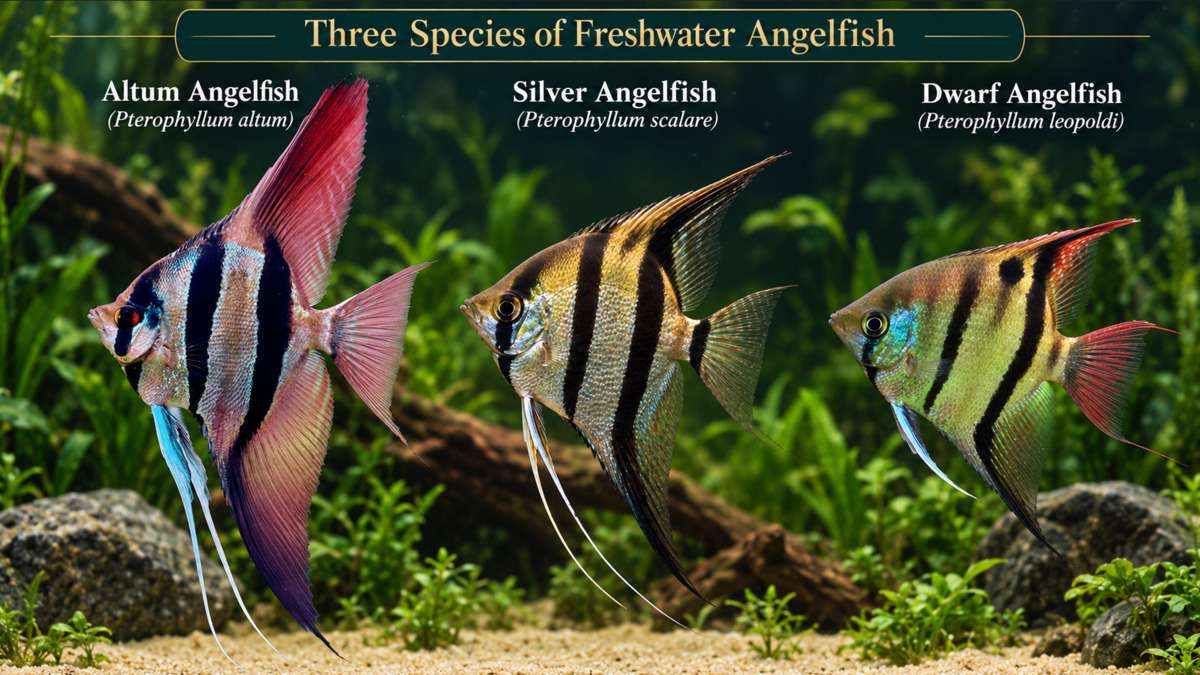
There are three distinct species of freshwater angelfish: Pterophyllum altum, Pterophyllum leopoldi and Pterophyllum scalare. Most freshwater angelfish sold in aquarium stores are selectively bred varieties of P. scalare. In contrast, altum angelfish (P. altum) and dwarf angelfish (P. leopoldi) are much rarer in the aquarium hobby and are more commonly wild-caught, as successful captive breeding is considerably less common.
The many different types of angelfish commonly seen in aquariums are more accurately described as varieties or phenotypes of Pterophyllum scalare (P. scalare). This distinction is important when identifying freshwater angelfish: Altum, Leopoldi and Scalare refer to species within the Pterophyllum genus, while Koi, Zebra, Ghost, Silver, Marble, Albino and many others are varieties of P. scalare. Altum angelfish is the common name for P. altum, while dwarf angelfish is commonly used for P. leopoldi.
Freshwater Angelfish Types & Varieties
Below, you can explore 22 different types of freshwater angelfish with pictures and identifying characteristics to help tell each one apart. Compare their colors, patterns, markings and other distinctive features to identify your angelfish and learn more about each species and variety.
Altum Angelfish

The altum angelfish is the only angelfish belonging to the species Pterophyllum altum. It is the largest of the three freshwater angelfish species, growing upwards of 14–16 inches in height and 7 inches in length. A 90-gallon aquarium should be the bare minimum for these fish, although 125 gallons or larger is preferable to provide enough swimming space.
They are easily distinguished from their close relatives. To identify them, look for three prominent vertical black and brownish stripes. True altums that have not been bred with Pterophyllum scalare have an incision directly below their eyes along the ridge of their nose.
Before purchasing altum angelfish you should inquire into whether the altum’s origins are either wild-caught or captive bred. Wild-caught altums may not readily accept commercially prepared foods and may initially require live foods before being slowly weaned onto frozen and dried foods.
Dwarf Angelfish

The dwarf angelfish is recognized as the only member of the Pterophyllum leopoldi species, they are not only the smallest but also the most aggressive angelfish species. However, they frequently only chase away fish that swim too closely; as a result, fish with long-flowing fins and slow moving are not ideal tank mates.
One of the easiest ways to identify a dwarf angelfish (P. leopoldi) is by its smaller size when mature, averaging 6.3 cm (2.5 inches) in height and 5 cm (2 inches) in length. Other distinctive characteristics include a black spot below the dorsal fin, a reddish hue along the dorsal fin, and a red tail.
Considering that they are primarily wild-caught, dwarf angelfish may not readily accept commercially prepared food, live feedings may be necessary while weaning them onto dried or frozen foods. Finding out where they came from could provide you with the knowledge you need to feed them appropriately.
Zebra Angelfish

Due to their similar features, silver angelfish and zebra lace angelfish are sometimes mistaken for one another. The zebra angelfish has one or two additional black vertical stripes, whereas a silver angelfish has four vertical stripes.
Fish with black pigmentation are substantially less common; retailers rarely have angelfish breeds with this particular phenotype. More frequently, you can find hybrids of silver angelfish and zebras in stores.
Pearlscale Angelfish

Pearlscale angelfish is an appropriate name since their pure white body shimmers in light due to their wrinkly scales which reflect light. Albino angelfish do not have a scale mutation, in contrast to its close relative the pearlscale.
This phenotype will not always be pure white. They may possess slight black, blue, copper, and other light-colored hues on their fins. Under the right lighting, these slight off-colors may become more noticeable.
Black Ghost Angelfish

Black ghost angelfish are occasionally mistaken for their closest relative, the black hybrid. The difference between the two is that black hybrid angelfish will have a mix of gold and faded black scales, whereas the black ghost is jet black in color.
This particular angelfish phenotype looks phenomenal in heavily planted aquariums; in aquascapes with lighter themes, they can become the focal point or show fish.
Koi Angelfish

Koi angelfish and gold marble angelfish are two phenotypes that have comparable appearances. The easiest way to tell the two apart is that only the top of the body, the area around the dorsal fin, and the top of the head are primarily orange on the gold marble angelfish, while koi angelfish display more orange with black blotches across their entire body.
This angelfish breed can be rather difficult to find in stores due to its rarity, so if you see one don’t hesitate to bring a pair or two home.
Koi angelfish will look beautiful in most aquascapes, but integrating them into a tank with too many colorful fish may drown out their unique coloration. Fish that are either white, black, or orange will make for excellent tank mates.
Black Hybrid Angelfish

Black hybrid angelfish and black ghost angelfish are two phenotypes that have comparable appearances. The key distinction between the two is that while the black ghost angelfish will be completely black in color, the black hybrid angelfish will have a mixture of copper undertones and black coloration.
This is another angelfish variety that looks phenomenal in heavily planted tanks with a darker substrate.
Blue Leopard Angelfish

As a blue leopard angelfish matures and reaches adulthood, their markings continuously grow closer together. Additionally, they are one of Pterophyllum scalare’s rarest phenotypes and might be hard to locate in stores; if you do, don’t hesitate!
Daylight or white lights bring out the blue pigmentation in angelfish while in dimly lit aquariums they may look to be white rather than blue.
Leopard Angelfish

The leopard angelfish is similar to the blue leopard angelfish but without the blue pigmentation, and as they mature and reach adulthood, their markings continuously grow closer together.
Another uncommon phenotype, the patterns are usually inconsistent and random. Specialty angelfish breeders spend a great deal of time and effort in producing the most desirable patterns.
Blushing Angelfish

The term “blushing” refers to their distinctive pink gills, which are more pronounced while they are young and gradually fade as they get older. With a white body and occasionally an orange tint, generally on its upper half, these characteristics are frequently comparable to those of gold angelfish and albino angelfish.
Blushing angelfish may come in many different variations with small amounts of black, orange, and blue pigmentation.
Ghost Angelfish

With characteristics closely resembling the albino angelfish, it does not have pink eyes but rather a prominent black stripe running across its eyes. Although they lack the body stripes that are present in wild silver angelfish, ghost angelfish have a similar complexion.
When the correct lighting conditions are present, ghost angelfish may occasionally exhibit blue pigmentation, creating the impression that their scales are blue.
Albino Angelfish

The albino angelfish has a white body with translucent fins, red eyes, and occasionally a very slight orange color on the top of its body. This colorless phenotype results when an angelfish inherits the recessive albino gene from both parents.
An albino phenotype looks best in darker-themed aquascapes with plenty of rocks and driftwood located throughout the tank.
Halfback Angelfish

In contrast to smokey angelfish, halfback angelfish have a dark black hue in the back half of the fish with a distinct border. Two recessive half-black genes are also present in this phenotype, which makes them rather uncommon.
Most halfback variants are not true halfbacks since their color patterns are typically random and inconsistent.
Blue Angelfish

One of the rarest phenotypes of Pterophyllum scalare are found in blue angelfish, which have a recessive mutation that is relatively new and whose origins are unknown. It is made up of two recessive genes and enhances iridescence in all strains while significantly reducing the storage of carotenoid pigments.
The price of this fish considerably increases the more prominent the blue coloring is. It takes a lot of time and effort for specialty breeders to preserve this trait through selective breeding.
Chocolate Angelfish

The chocolate angelfish phenotype results from combining the smokey and zebra genes through selective breeding. With the exception of their head, these phenotypes have a dark, frequently inconsistent, black and brownish color all over their bodies. In some cases, smokey angelfish are commonly confused with incorrectly referred to as chocolate angelfish. Unlike chocolate angelfish, smokey angelfish contain two copies of the smokey gene.
In natural-looking aquascapes with driftwood and aquatic plants, this phenotype may seem like it would blend in but it looks rather beautiful!
Smokey Angelfish

The smokey angelfish only has one smokey gene, as opposed to the chocolate angelfish’s two. Their fins and the rear of this phenotype display black and grey patterns, while the rest of their body has softer colorations.
This angelfish variation will look great in rock aquascapes with other similar or darker-colored species of fish. Any brightly colored show fish or schools of fish would act as the centerpiece of your aquarium.
Black Lace Angelfish

When an angelfish carries both the dark gene and the wild-type gene of the silver angelfish, black lace angelfish are the result. This phenotype contains three vertical stripes similar to the silver angelfish, with an extremely darkened complexion.
In aquariums with lots of plants, this variation of angelfish looks amazing, and in aquascapes with lighter themes, black lace angelfish will serve as a focal point or show fish.
Silver Angelfish

The original wild variety of silver angelfish (Pterophyllum scalare) has three vertical body stripes that extend between the dorsal and anal fins, one in the middle, and one across the eyes. Red eyes and some coloring on their upper side are features that the majority of wild types exhibit.
These fish can still be found swimming in the wild. The many selectively bred varieties of Pterophyllum scalare found in the aquarium hobby were developed from wild-caught scalare angelfish.
Gold Angelfish

In contrast to the gold marble angelfish, gold angelfish have a predominantly white body with yellow and orange hues that are usually most noticeable around the head and dorsal fin. Due to the recessive nature of the gold gene, two copies are necessary for this phenotype.
There are not many species of fish available in the aquarium hobby with yellow pigmentation. If you are looking for a more brightly colored angelfish, this phenotype would make a great addition to your tank.
Gold Marble Angelfish

A gold or yellowish upper body typically on their head contrasts with the main body’s mixture of black and white coloring on gold marble angelfish. In certain cases, the entire body exhibits this gold/orange patterning. They are among the most popular angelfish on the market and come in a wide variety.
Throughout many years of selective breeding, there have been many angelfish varieties that have lost their distinguishable vertical stripes often associated with the angelfish species.
Pink Angelfish

This genetically modified pink angelfish was developed by Taiwanese biotechnologists in 2012 as part of a collaboration between Jy Lin, a private biotechnology business, National Taiwan Ocean University, and Taiwan’s Academia Sinica.
The pink angelfish variant is the newest phenotype of angelfish, and if you’re looking for a species that is brightly colored, look no further!
Clown Angelfish

Both the zebra and the stripeless genes are present in equal amounts in clown angelfish. This phenotype has white and silver undertones with inconsistent patches of black stripes and dots throughout their entire body.
If any additional colors are present, they might be a hybrid of different angelfish varieties since clown angelfish only display white and black coloring.
Frequently Asked Questions
What is the rarest freshwater angelfish?
Altum angelfish (P. altum) and dwarf angelfish (P. leopoldi) are the rarest freshwater angelfish in the aquarium trade. Of the two, Dwarf Angelfish are generally the hardest to find.
Which angelfish is the best for beginners?
All varieties of P. scalare are the best choice for beginners. They are hardy, widely available, and generally easier to care for than P. altum or P. leopoldi angelfish.
Are all freshwater angelfish the same species?
No. There are three distinct species of angelfish: P. altum, P. leopoldi, P. scalare. Most angelfish sold in aquarium stores are varieties of P. scalare.
What is the largest freshwater angelfish?
No. There are three distinct species of angelfish: P. altum, P. leopoldi, P. scalare. Most angelfish sold in aquarium stores are varieties of P. scalare.
What colors do angelfish come in?
Freshwater angelfish come in a wide variety of colors, including white, silver, black, gold, orange, blue and many more. Selective breeding of the P. scalare has also produced varieties with stripes, spots, marbling, blotches, with many different combinations of colors, including Koi, Zebra, Marble, Leopard, and Clown angelfish.
About Our Species Profiles
ForAquarium species guides combine scientific literature and established taxonomic references with years of aquarium-keeping experience. Information is periodically reviewed and updated as new research becomes available.
Published Literature
Torres-Tabares Alexander, Velasco-Santamaria, Yohana María, and Ramirez-Merlano Juan A. Morphological, morphometric and meristic characteristics of larvae of altum angelfish (Pterophyllum altum) (2014)
Zhongpu Li, Zaizhong Chen, Jianzhong Gao, Lei Wang, Xiaowu Chen, and Yuming Zhao. The complete mitochondrial genome of the Altum Angelfish Pterophyllum Altum (Pellegrin, 1903) (2015)
Chanelle Anderson. A molecular phylogenetic study of the South American fish genus Pterophyllum (2016)
Leonard P. Schultz. A Review of the Pompadour or Fresh-Water Angelfishes, Genus Pterophyllum (1967)
Madireddy. First Ever Whole Genome Sequencing and De Novo Assembly of the Freshwater Angelfish, Pterophyllum scalare (2022)
Gómez-Laplaza. Recent social environment affects colour-assortative shoaling in juvenile angelfish (2009)
Li et al. The complete mitochondrial genome of the altum angelfish Pterophyllum altum (2015)



Fantastic article, very informative. You should continue your
writing. I’m confident, you have a great readers’ base already!