
Species Classification
Order: Cypriniformes
Family: Danionidae
Subfamily: Danioninae
Genus & Species: Devario aequipinnatus
Common Names: Giant Danio, Blue Giant Danio
Species Data Sheet
Temperature: 77–82°F (25–28°C)
pH Range: 6.0–8.0
General Hardness (GH): 5–19 dGH
Total Length: 15 cm (5.9 inches)
Average Length: 7–10 cm (2.8–4 in)
Care Level: Beginner
Lifespan: 5–7 years
Min Tank Size: 40 gallons
Temperament: Peaceful
Swimming Level: Middle to Upper water column
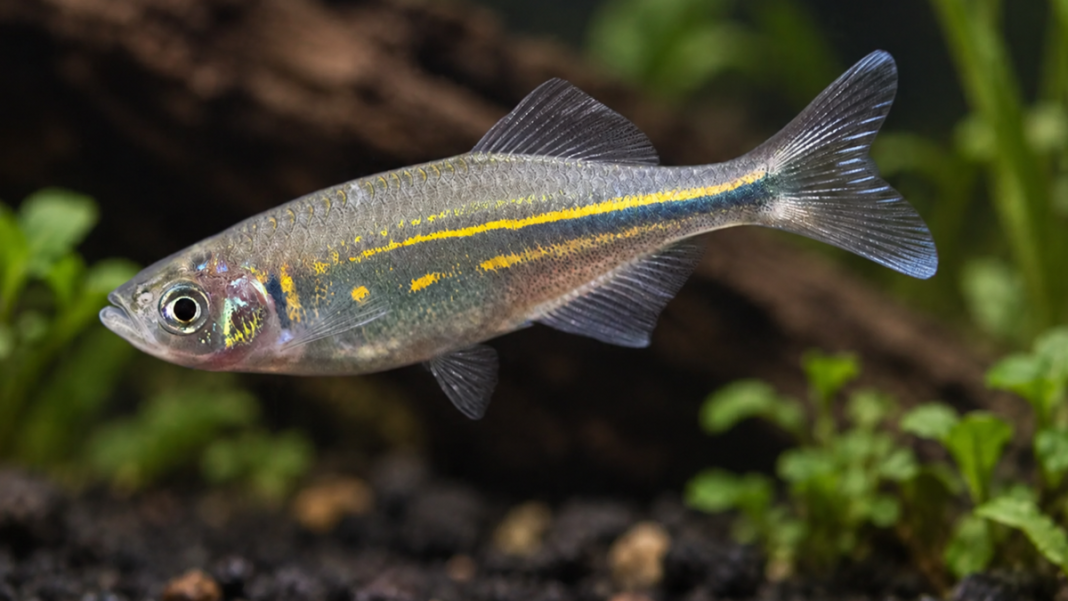
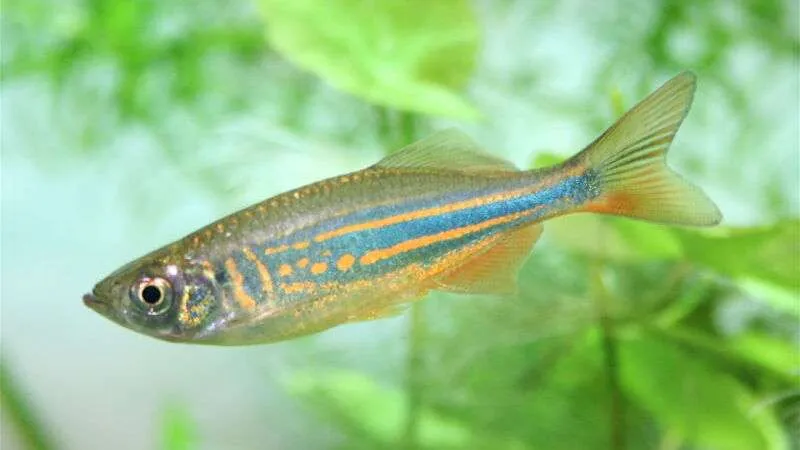
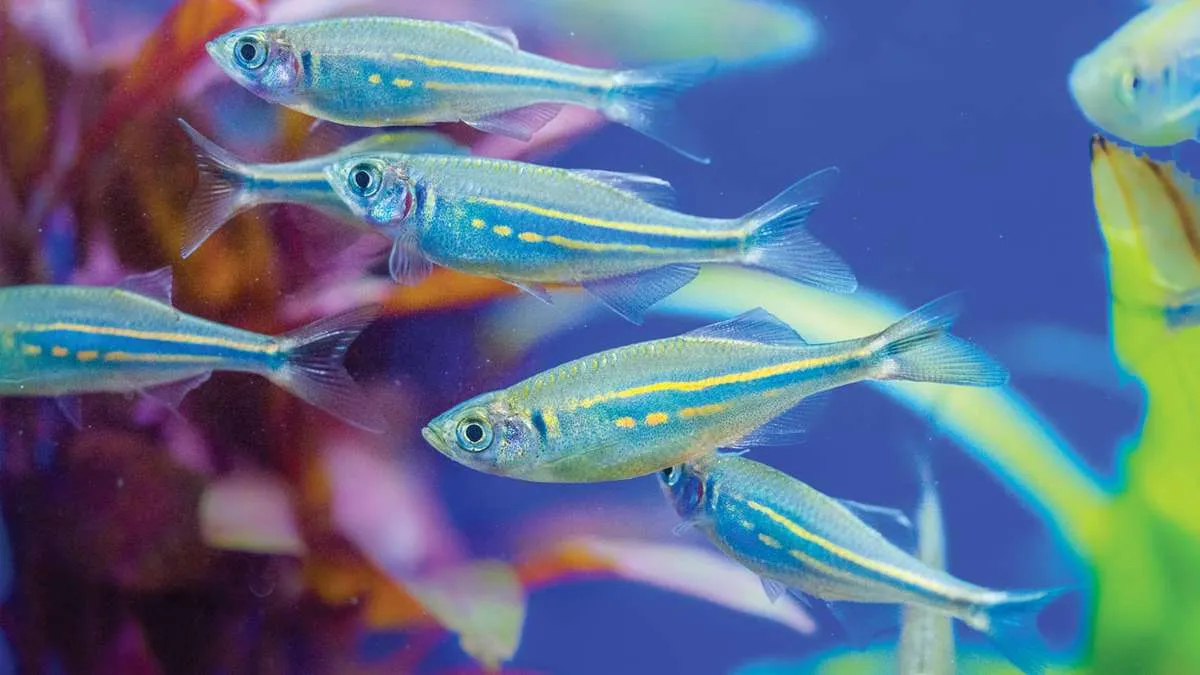
The giant danio (Devario aequipinnatus) is a large, highly active freshwater schooling fish that can be seen constantly swimming throughout the aquarium. As a social species, giant danios should be kept in groups of at least six, with larger groups preferred when aquarium size permits.
Much of the older aquarium and scientific literature on the giant danio (Devario aequipinnatus) actually contains information relating to other Devario species, most commonly the Malabar danio (Devario malabaricus). This taxonomic confusion remains important when interpreting older information on the giant danio’s appearance, maximum size and other characteristics, as some information in older publications may actually refer to its close relatives.
Origin & Natural Habitat
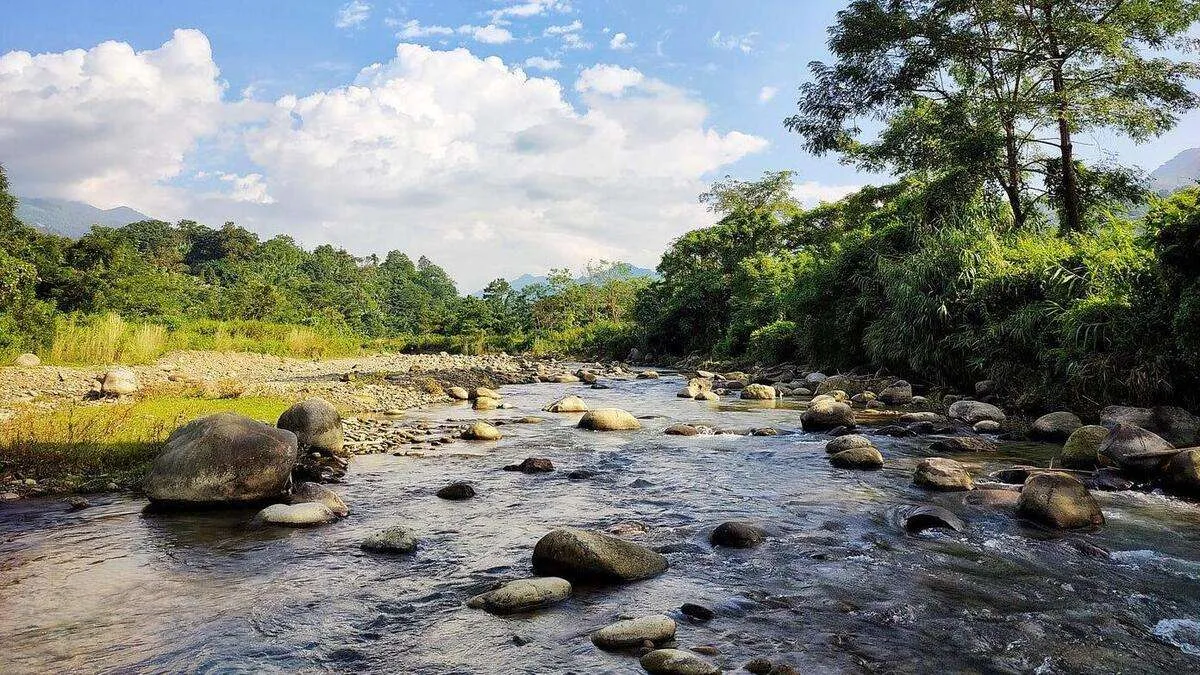
Giant danios are native to South Asia, with their modern distribution generally recognized within the Ganga, Brahmaputra and Meghna basins of northern and northeastern India, Bhutan, Nepal and Bangladesh. Older publications attributed a considerably wider distribution to D. aequipinnatus, including other regions of South and Southeast Asia. However, many historical records are in question because several similar Devario species were previously identified as D. aequipinnatus.
Their natural habitat consists primarily of clear, shaded hill streams with flowing water and substrates containing gravel, pebbles and larger rocks. These environments are generally associated with forest cover and vegetation along the banks, providing areas of shade over the water.
Giant danios have been observed forming schools near the surface of small, high-gradient hill streams. Their association with flowing water and open swimming areas helps explain their high activity levels and preference for water movement when maintained in an aquarium.
Research highlight: A 2017 taxonomic study of Devario in Bangladesh found D. aequipinnatus in small numbers within fast-flowing forest streams. The researchers concluded that many historical records attributed to giant danios require caution because D. aequipinnatus and D. malabaricus have repeatedly been confused in scientific literature.
Giant Danio Care
Giant danios are hardy aquarium fish when provided with clean, well-oxygenated water, adequate swimming space and a large enough group of their own species. Their high activity level and relatively large adult size make aquarium length and group size particularly important.
They are best maintained in a mature aquarium with established biological filtration and stable water conditions. Ammonia and nitrite should remain at 0 ppm, while nitrate should be controlled through appropriate stocking levels, regular water changes and routine aquarium maintenance.
Tank Size
A 40+ gallon aquarium should be considered the minimum for a small group of giant danios, with aquarium length being more important than height. A tank approximately 100 cm (39 inches) long or longer provides the swimming space needed by this fast, highly active species, although larger aquariums are preferable for larger groups or additional tank mates.
Giant danios spend considerable time swimming through the upper and middle columns of the aquarium, so a long aquarium provides substantially more swimming space than a tall aquarium of similar volume.
Giant danios should be kept in groups of at least six, with larger groups preferred when aquarium size permits. A tight-fitting lid is strongly recommended because giant danios are fast swimmers and capable jumpers.
Water Parameters
Giant danios can tolerate a relatively wide range of aquarium conditions. Recommended water parameters include:
Temperature: 72–82°F (22–28°C)
pH Range: 6.0–8.0
General Hardness (GH): 5–19 dGH
Stable water conditions are generally more important than maintaining an exact value within these ranges. Sudden changes in temperature or water chemistry should be avoided. Warmer temperatures can also influence the activity and social behavior of giant danios.
Research highlight: Bartolini, Butail and Porfiri examined giant danios maintained at 22°C (71.6°F), 25°C (77°F) and 28°C (82.4°F). Giant danios were most active at 28°C, while lower temperatures reduced activity and resulted in more cohesive schooling behavior. These findings demonstrate that water temperature can influence both individual activity levels and the social organization of giant danio schools.
Aquarium Setup
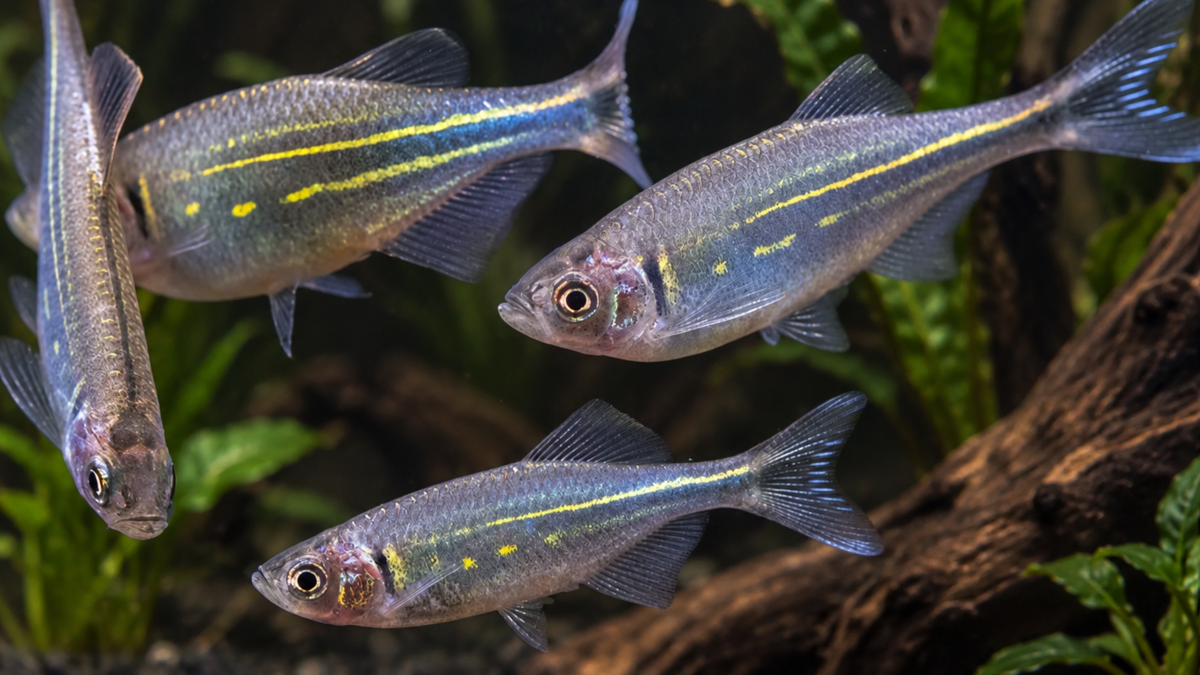
A naturalistic setup can combine gravel and rounded pebbles with larger rocks, driftwood and areas of sand. This mix of substrate and hardscape resembles elements of the clear, rocky hill streams where wild populations are found.
A gentle to moderate current within the aquarium can provide conditions similar to the flowing streams they naturally inhabit, although a strong current from a powerhead or filtration unit throughout the entire aquarium is unnecessary.
Plants, driftwood and other decorations can be placed along the sides and background of the aquarium. Larger aquariums can also include central decorations if there is enough space for giant danios to swim freely around them. Overhanging plants and floating vegetation can provide shaded areas similar to the forest cover associated with their natural habitat.
Diet & Feeding
Giant danios are omnivorous fish. In their natural habitat, they primarily feed on terrestrial and aquatic insects and other small prey found near the water’s surface, although worms and crustaceans are also consumed.
In captivity, giant danios readily accept a wide variety of commercially available foods. Use a high-quality tropical flake or appropriately sized pellet as their staple food, supplemented with protein-rich foods to provide a varied and nutritionally balanced diet.
Suitable supplemental foods may be offered live, frozen or freeze-dried and include:
- Bloodworms
- Brine shrimp
- Daphnia
- Mysis shrimp
- Small prawns
- Insects
- Insect larvae
- Mosquito larvae
Live and frozen foods can encourage natural feeding behavior and provide additional variety. Protein-rich foods should supplement their staple food rather than form the entirety of their diet.
Their natural tendency to feed near the surface makes floating and slow-sinking foods particularly suitable. Distribute food across the surface of the aquarium so that individuals throughout the school have an opportunity to feed.
Feed adult giant danios once or twice daily, providing only as much food as they can consume within a few minutes. Remove significant amounts of uneaten food to prevent excess waste from accumulating in the aquarium.
Budget Staple Food
Premium Staple Food

Supplemental Protein

Giant Danio Tank Mates
Giant danios are highly active social fish that should be maintained in groups of at least six, with larger groups preferred when aquarium size permits. They may swim together in tightly packed groups during periods of increased activity or when startled, while spreading more loosely throughout the aquarium when relaxed. When kept in smaller groups, some fish may be subjected to more frequent chasing, whereas a larger group helps spread chasing and social interactions among more individuals rather than concentrating them on only a few fish.
Although generally suitable for most community aquariums, their speed, size and constant activity can intimidate slow-moving or timid species. Suitable tank mates include appropriately sized danios, barbs, tetras, rainbowfish, livebearers, corydoras and loaches that are not easily intimidated by their energetic behavior.
Feeding habits should also be considered when selecting tank mates. Giant danios are highly active feeders and may consume most of the food before it reaches slower fish that feed near the bottom of the aquarium. When keeping giant danios with bottom-dwelling species, sinking foods can be provided to ensure these fish receive enough food.
Compatible Tank Mates
LOACHES & LIVEBEARERS
✅ Yo-Yo Loach
✅ Zebra Loach
✅ Clown Loach
✅ Swordtail
✅ Platy
✅ Molly
TETRAS & RAINBOWFISH
✅ Black Skirt Tetra
✅ Buenos Aires Tetra
✅ Congo Tetra
✅ Boesemani Rainbowfish
✅ Dwarf Neon Rainbowfish
✅ Turquoise Rainbowfish
BOTTOM-DWELLERS
✅ Bronze Corydoras
✅ Sterbai Corydoras
✅ Emerald Corydoras
✅ Bristlenose Pleco
✅ Rubber Lip Pleco
✅ Hoplo Catfish
Note: Individual temperament can vary; species that coexist peacefully in one aquarium may not do so in another. Monitor newly introduced fish for excessive fin-nipping, fin damage, persistent aggression, or signs of stress, and separate incompatible fish when necessary.
Male vs Female Differences
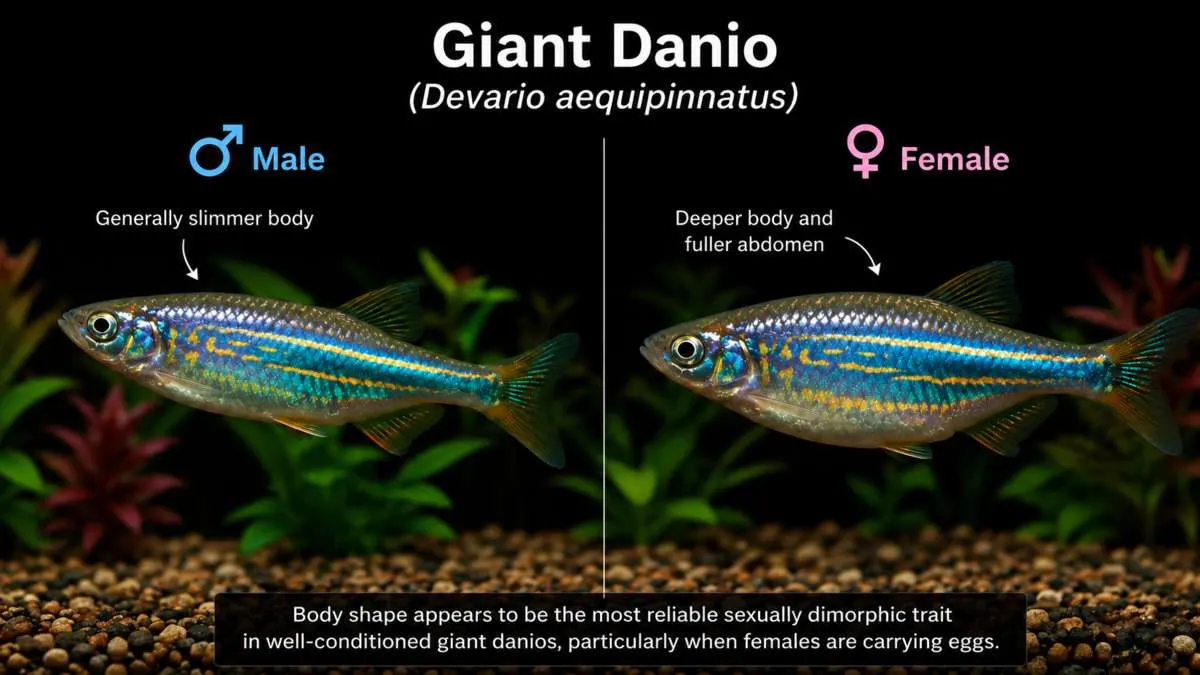
Male and female giant danios are similar in overall appearance, making them rather difficult to distinguish reliably. Mature females develop a deeper, fuller abdomen when carrying eggs, while males remain slimmer.
Body shape is the most reliable method for distinguishing males from females, although differences are only visually apparent when the fish are in breeding condition. Coloration and body markings do not reliably distinguish the sexes.
Giant Danio Breeding Guide
Giant danios are relatively easy to breed under suitable aquarium conditions, provided egg predation is kept to a minimum, as adults readily consume their own eggs. Spawning may even occur in a mature community aquarium when dense plants and a rocky aquascape allow some eggs to fall into crevices and escape predation, although a dedicated breeding aquarium greatly improves their chances of survival.
Giant danios are egg scatterers that exhibit no parental care. Although females can produce large numbers of eggs, only a very small fraction may survive to become free-swimming fry in a community aquarium, where adult giant danios, other fish, filtration and unsuitable water movement can significantly reduce survival rates.
Conditioning Giant Danios for Breeding
To begin conditioning, mature males and females should be given frequent small feedings of nutrient-rich live or frozen foods such as daphnia, brine shrimp, bloodworms and insect larvae throughout the day. As females develop more eggs, their abdomens become noticeably fuller and rounder. Once the females appear heavily gravid, they are ready to be moved into the breeding aquarium.
Spawning & Egg Care
When selecting the breeding group, try to maintain an even number of males and females. Approximately half of the group should consist of females with noticeably rounded abdomens, while the other half should consist of slimmer males. Smaller breeding groups, such as five males and five females, can help reduce egg predation by limiting the number of adults present while still providing multiple breeding pairs.
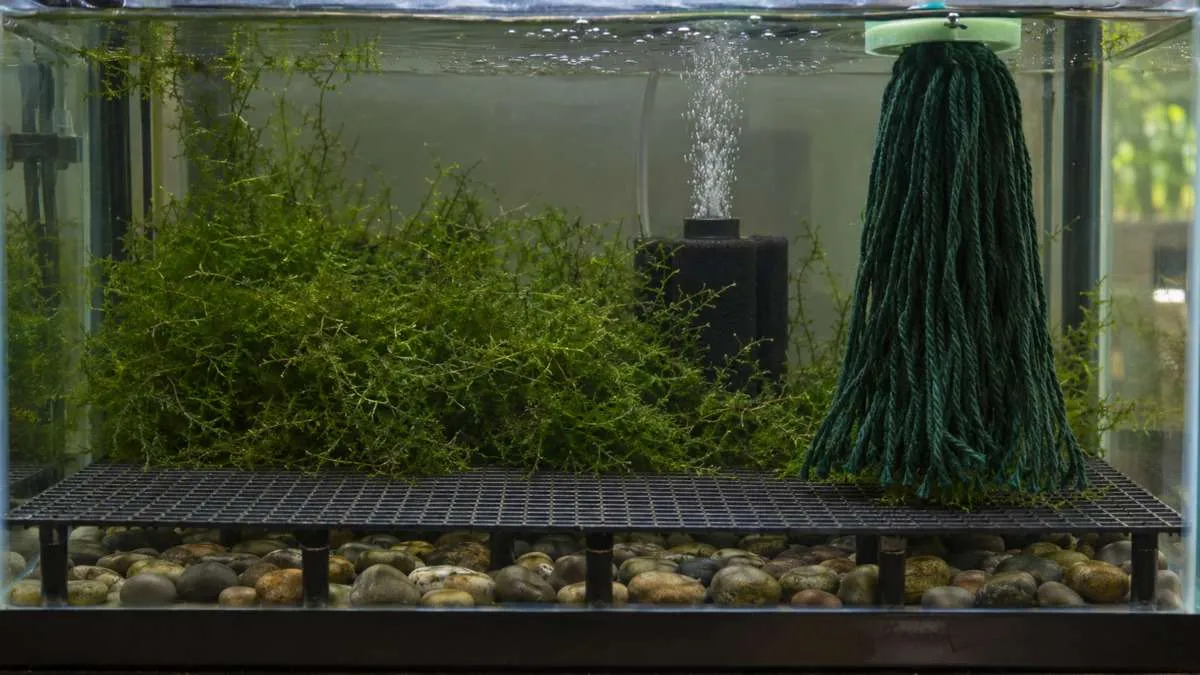
The breeding aquarium should contain fine-leaved plants or spawning mops, as giant danios typically prefer scattering their eggs among plants when available, although eggs are also scattered elsewhere. A mixture of small, medium and larger rocks can also be placed across the bottom of the aquarium, allowing eggs to fall into gaps where adults cannot easily reach them. For additional protection, a raised mesh barrier can be positioned above the substrate so that eggs fall through the openings and remain out of reach of the adults. Combining plants, spawning mops and a rocky substrate provides greater protection from egg predation and increases the number of eggs that survive to hatch.
An air-driven sponge filter provides the best method of biological filtration and oxygenation for a breeding aquarium while helping reduce mortality rates associated with strong filter intakes and excessive water current, particularly among newly hatched fry that are not yet capable swimmers.
Maintain the breeding aquarium with relatively soft, near-neutral water and initially keep the temperature toward the upper end of the giant danio’s preferred range:
- Temperature: 77–81°F (25–27°C)
- pH Range: 6.5–7.0
- General Hardness (GH): 3–4 dGH
Introduce the selected breeding group into the aquarium during the late evening. After the fish have been introduced, gradually reduce the water temperature by 3–5°C (5–9°F) over the course of a few hours to help encourage spawning. This should bring the breeding aquarium closer to a spawning temperature of 22.5°C (72.5°F), depending on the initial temperature.
Giant danios typically spawn early in the morning shortly after the aquarium lights come on. Males will pursue receptive females as they scatter their eggs among plants or other surfaces, where the eggs are externally fertilized by the males. Once spawning has finished and eggs are noticed, remove the adults to prevent them from consuming the eggs.
Giant danio eggs typically hatch within approximately 24–36 hours, depending on temperature and other aquarium conditions. Newly hatched larvae are extremely small and initially show very little movement, remaining relatively inactive until they develop further and become free-swimming within the following few days.
Research highlight: Approximately 1,183–2,480 eggs per female have been reported in captive D. aequipinnatus, with hatching rates of approximately 82–84% under successful breeding conditions. The study used relatively soft water at approximately 2.8 dGH (50 mg/L CaCO₃), a pH of 7.0, and a temperature of 22.5°C (72.5°F). The maximum recorded egg count demonstrates the high reproductive potential of the females studied and should not be interpreted as the number of eggs or surviving fry expected from a typical aquarium.
Raising Giant Danio Fry
Once the adults have been removed, the water level can be lowered so that approximately 6–10 inches (15–25 cm) remains, depending on aquarium size. The shallower water concentrates microscopic foods within a smaller volume, making it easier for newly free-swimming fry to locate food.
Airflow through the sponge filter should be reduced to only a few bubbles per second after the eggs are noticed, providing oxygenation with very little current. Conventional filtration units, powerheads and other equipment producing strong circulation should be avoided during early development. Newly hatched larvae are not yet strong swimmers, and excessive current can continually move them around the aquarium or force the fry to expend energy swimming against the flow, potentially contributing to higher mortality rates.
Once the fry become free-swimming, cultured infusoria are an excellent first food, while other options such as paramecium and finely powdered or liquid commercial fry foods can also be offered several times per day while carefully controlling excess feeding. Newly hatched brine shrimp, microworms, and progressively larger foods can be introduced as the fry grow and become large enough to consume them, typically beginning around the second week after hatching.
Research highlight: Captive larval rearing of D. aequipinnatus has successfully used infusoria during the first week, followed by rotifers, Artemia nauplii and microworms during the second week, cladocerans during the third week and prepared flake food beginning in the fourth week. This progression allows food size to increase alongside the developing fry.
As the fry develop, the water level and sponge-filter airflow can gradually be increased over the following 2–4 weeks. Normal water depth and filtration can eventually be restored once the juveniles have developed enough to comfortably cope with the additional current.
Species Overview

The giant danio was originally described by John McClelland in 1839 as Perilampus aequipinnatus. As the classification of South Asian danionin fishes was revised, the species was later placed in the genus Devario and is now recognized as Devario aequipinnatus.
The taxonomic history of the species is unusually complicated. For many years, D. aequipinnatus was used broadly for striped Devario populations distributed across large portions of South and Southeast Asia. Some authors also treated the Malabar danio (D. malabaricus) as a synonym of D. aequipinnatus, contributing to considerable confusion concerning the distribution, appearance and biology of both species.
Modern taxonomic research recognizes D. aequipinnatus and D. malabaricus as separate species. Consequently, older aquarium and scientific references describing “giant danios” cannot always be assumed to refer to true D. aequipinnatus.
Giant Danio vs Malabar Danio
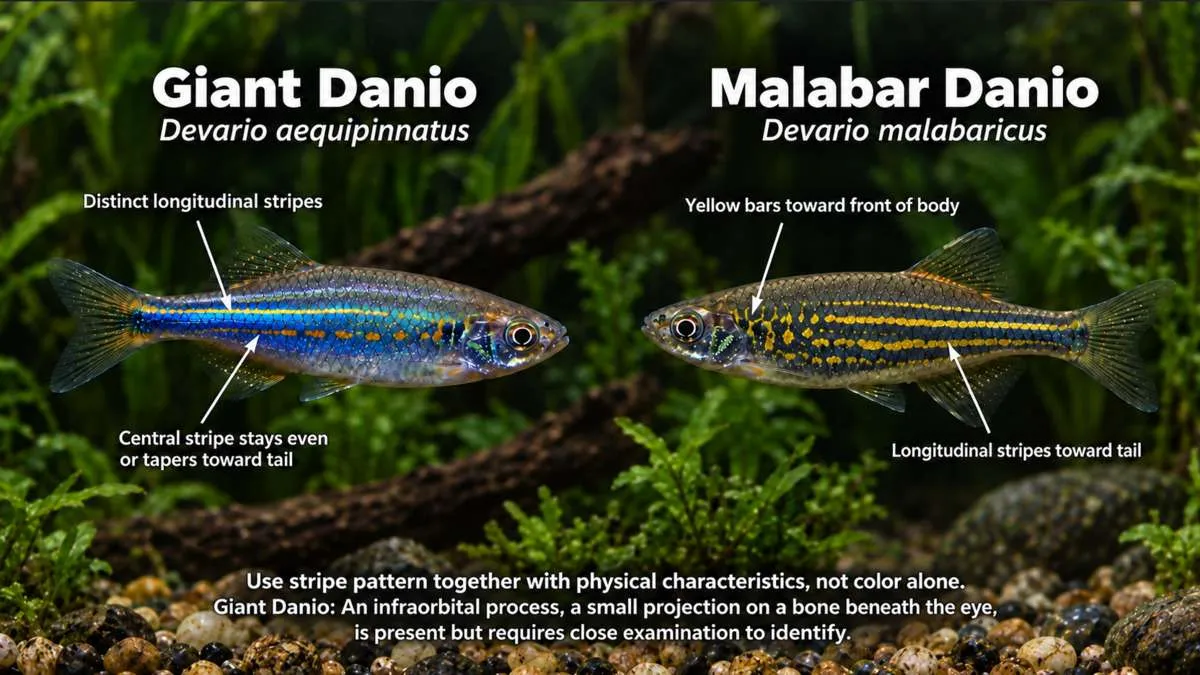
The giant danio (Devario aequipinnatus) and Malabar danio (Devario malabaricus) have historically been confused with one another, and the names have sometimes been used interchangeably in older aquarium and scientific literature.
Modern taxonomic work separates the two species using a combination of coloration and morphological characteristics rather than body coloration alone.
True D. aequipinnatus has a characteristic arrangement of distinct longitudinal stripes, including a prominent central P stripe accompanied by P+1 and P−1 stripes. The central stripe remains relatively consistent in width or tapers slightly toward the tail. The species also possesses an infraorbital process, a morphological feature that helps distinguish it from D. malabaricus and several other striped Devario species from southern India.
The P stripe runs longitudinally along the middle of the side of the body. The P+1 stripe runs parallel immediately above the P stripe, while the P−1 stripe runs parallel immediately below it. These designations allow the position and pattern of the longitudinal stripes to be described consistently when distinguishing D. aequipinnatus from other Devario species.
Because these diagnostic characteristics can be difficult to identify on living aquarium fish, particularly without close examination, fish sold commercially as “giant danios” should not automatically be assumed to represent D. aequipinnatus.
This distinction is important when interpreting aquarium information. Differences in reported adult size, distribution, coloration and other characteristics may sometimes reflect records of D. malabaricus or another related Devario rather than true D. aequipinnatus.
Photo Gallery
FAQs
How Many Giant Danios Should Be Kept Together?
Giant danios should be kept in groups of at least six, although larger groups are preferred when aquarium size permits. They are highly social fish, and keeping a larger group allows their schooling and social behaviors to be expressed while evenly distributing chasing and other interactions among more individuals.
Are Giant Danios Aggressive?
Giant danios are generally peaceful but are extremely active and may chase one another as part of their normal social behavior. Their constant activity can intimidate slow-moving or timid fish, while keeping too few giant danios can result in more frequent chasing and increased stress within the group. Keeping at least six giant danios with appropriately sized, active tank mates helps reduce compatibility problems.
Can Giant Danios Live With Goldfish?
Giant danios can live with goldfish because their temperature requirements overlap, particularly when goldfish are maintained toward the warmer end of their acceptable range. However, compatibility depends on aquarium size, water temperature and the type of goldfish being kept. Giant danios are fast, active feeders and may outcompete slower fancy goldfish for food, making streamlined goldfish varieties generally more suitable tank mates.
How Long Do Giant Danio Eggs Take to Hatch?
Giant danio eggs generally hatch within approximately 24–36 hours, with development influenced by water temperature and other aquarium conditions. The adults provide no parental care and readily consume their own eggs, so eggs should be protected with fine-leaved plants, spawning mops or a rocky substrate, followed by removing the adults once spawning has finished.
Do Giant Danios Need a Heater?
Giant danios should generally be kept at approximately 72–82°F (22–28°C). A heater may not be necessary when the aquarium naturally remains stable within this range, but a heater is recommended when room temperatures fluctuate or regularly fall below the desired temperature. Research has also shown that water temperature influences giant danio activity and schooling behavior, so maintaining a stable temperature is preferable.
About Our Species Profiles
ForAquarium species guides combine scientific literature and established taxonomic references with years of aquarium-keeping experience. Information is periodically reviewed and updated as new research becomes available.
Published Literature
Sven O. Kullander, Md. Mizanur Rahman, Michael Norén, and Abdur Rob Mollah. Devario in Bangladesh: Species diversity, sibling species, and introgression within danionin cyprinids (Teleostei: Cyprinidae: Danioninae) (2017)
Sudesh Batuwita, Madura de Silva, and Sampath Udugampala. A review of the genus Devario in Sri Lanka (Teleostei: Cyprinidae), with description of two new species (2017)
Tiziana Bartolini, Sachit Butail, and Maurizio Porfiri. Temperature influences sociality and activity of freshwater fish (2015)
M. M. McClure, P. B. McIntyre, and A. R. McCune. Notes on the natural diet and habitat of eight danionin fishes, including the zebrafish Danio rerio (2006)
Khusbu Samal, Pradyut Biswas, Soibam Khogen Singh, and others. Dietary Melatonin Boosts Reproduction and Growth Performance of Ornamental Fish Giant Danio (Devario aequipinnatus): A Transformative Approach for Scrapping Wild-Caught Fish Business (2025)
Michael R. Conith, D. Ringo, A. J. Conith, A. Deleon, M. Wagner, S. McMenamin, C. Cason, and W. James Cooper. The Evolution of Feeding Mechanics in the Danioninae, or Why Giant Danios Don’t Suck Like Zebrafish (2022)
A. Chicoli, S. Butail, Y. Lun, J. Bak-Coleman, A. Coombs, T. Paley, and M. Porfiri. The effects of flow on schooling Devario aequipinnatus: school structure, startle response and information transmission (2014)
William N. Eschmeyer, Ron Fricke, and Richard van der Laan. Catalog of Fishes: Devario aequipinnatus (2026)
Chandra Prakash, M. P. Singh Kohli, Kiran Dube, A. M. Babitha Rani, S. Dam Roy, K. D. Raju, and N. A. Pawar. Studies on Captive Breeding and Larval Rearing of Danio aequipinnatus (McClelland, 1839) (2014)